What "Units" Means on Your Syringe
Units are the lines on the syringe.
That is the whole answer. If a label says 20 units, most people pull the plunger back until the top of the stopper sits on the line marked 20. There is nothing to convert and nothing to measure in milligrams. It is liquid drawn up to a numbered line.
Your prescribed number is typically written in two places:
On the label on the side of your vial
On the paper that came in your box
These should match. If they do not, most people stop and contact their care team before injecting anything.
Your prescribing clinician and dispensing pharmacy are the authority on your dose. If their instructions differ from anything described here, follow theirs.
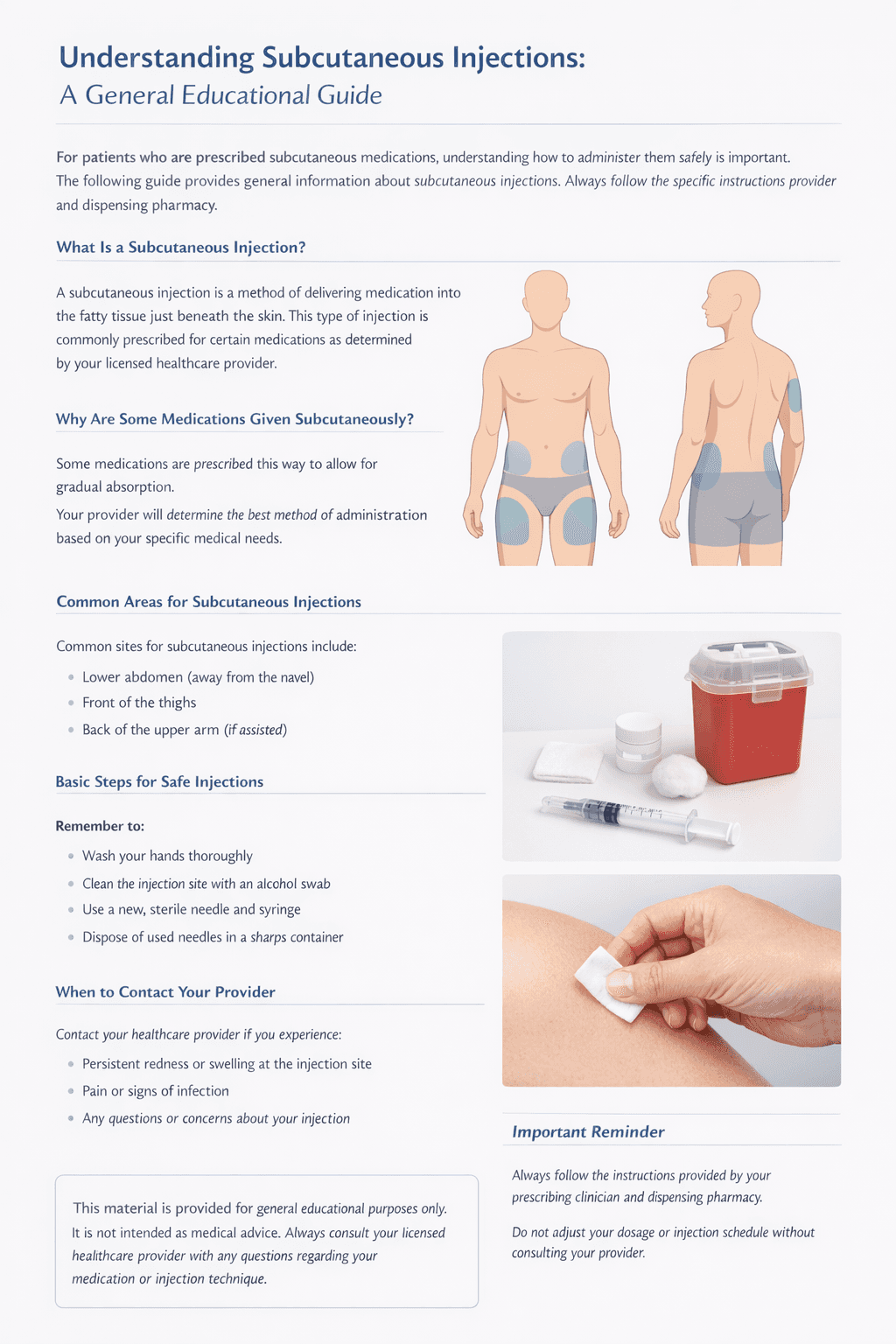
What Is a Subcutaneous Injection?
A subcutaneous injection is a method of delivering medication into the fatty tissue just beneath the skin. This layer sits between the skin and the muscle.
Certain medications are prescribed to be administered this way based on clinical judgment. Your licensed healthcare provider determines the appropriate route of administration for your specific medical needs.
Subcutaneous injections are commonly used because they allow medication to be absorbed gradually into the bloodstream.
Why Are Some Medications Administered Subcutaneously?
Healthcare providers may prescribe medications to be administered subcutaneously for several reasons, including:
Controlled, steady absorption
Suitability for at-home administration when appropriate
Established clinical use for specific types of medications
The method of administration is determined by your provider based on your medical history, treatment plan, and safety considerations.
If you have questions about why your medication is prescribed this way, consult your clinician directly.
Common Areas for Subcutaneous Administration
Subcutaneous injections are typically administered in areas where there is a layer of fatty tissue beneath the skin.
Common general areas include:
Lower abdomen, away from the navel (pinching fat)
Front of the thighs (pinching fat)
Back of the upper arm, when assisted (pinching fat)
Your provider may recommend specific areas that are appropriate for you. Always follow the guidance given with your prescription.
How Most People Draw a Dose
What follows is a general description of how subcutaneous injections are commonly performed at home. It is not instruction for your specific prescription, and it does not replace the guidance provided by your clinician or dispensing pharmacy.
Most people lay out the vial, one new syringe, two alcohol wipes, and a sharps container, and wash their hands before starting. If the vial is refrigerated, many take it out a few minutes early, since a cold injection tends to sting more than a room-temperature one.
The liquid is usually checked first. It should be clear. If it looks cloudy, discolored, or has particles floating in it, most people set it aside and contact their care team rather than using it.
From there, the usual sequence looks like this:
Wipe the rubber top of the vial with an alcohol wipe and let it air dry.
Pull the plunger back to the prescribed unit number, drawing air into the syringe.
Push the needle through the center of the rubber top and push that air into the vial, which makes the liquid easier to draw.
Turn the vial upside down with the needle still in it, and pull the plunger back until the stopper reaches the unit line.
Check for air bubbles. Flicking the side of the syringe brings them to the top, and pushing the plunger gently clears them. If the level drops below the line, draw back up to it.
Pull the needle out of the vial.
Clearing bubbles matters because air takes up space where medication would otherwise be, which can mean a short dose.
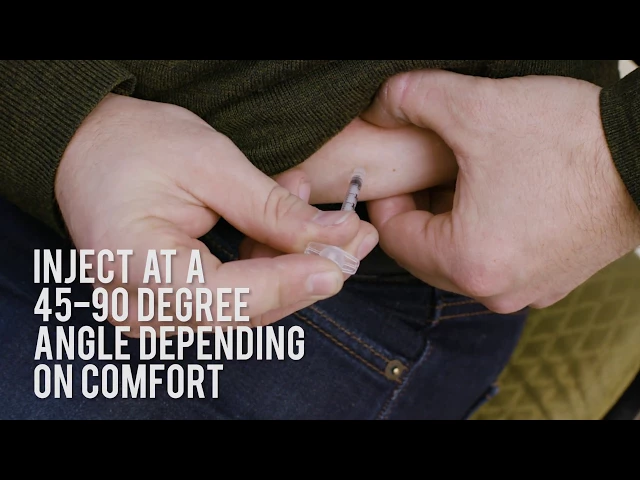
How Most People Give the Injection
Wipe the chosen site with the second alcohol wipe and let it dry completely. Injecting through wet alcohol is what causes much of the stinging people describe.
Pinch a fold of skin between thumb and finger.
The needle goes fully in, at 90 degrees, straight in. These needles are short and thin and designed to go all the way.
Press the plunger down steadily until it stops, without rushing it.
Most people count to five before withdrawing, so the dose does not track back out along the needle path.
Release the pinch. Rubbing the site is generally avoided; light pressure with clean gauze handles a drop of blood.
The whole syringe goes into a sharps container immediately and uncapped. Syringes are single-use and are not reused.
A drop of blood or a small bruise afterward is common and generally not a cause for concern.
Again, this describes common practice rather than your specific plan. The instructions that came with your prescription take precedence over anything here, and your care team is the right place to bring any question about your own technique or dose.
General Principles for Safe Administration
The following are general safety practices commonly associated with subcutaneous injections:
Wash your hands thoroughly before handling supplies
Clean the injection site with an alcohol swab and allow it to dry
Use a new, sterile needle and syringe for each administration
Dispose of used needles in an approved sharps container
Do not reuse needles or share injection supplies.
If your pharmacy provides specific handling or storage instructions, follow those directions carefully.
Video Overview: General Educational Demonstration
For patients who prefer a visual overview, the following publicly available video provides a general demonstration of subcutaneous injection technique.
This video is not produced by Vea and is provided for general educational reference only. It is not specific to any particular medication or prescription.
As with all educational materials, always follow the instructions provided by your prescribing clinician and dispensing pharmacy.
Important Note About Educational Content
This video is intended to provide a general understanding of subcutaneous administration. It does not replace medical advice, clinical training, or individualized instructions from your licensed healthcare provider.
Your prescribing clinician may provide specific guidance that differs from general demonstrations. Always defer to the instructions that accompany your prescription.
If you have any questions about your medication or administration technique, contact your provider directly.
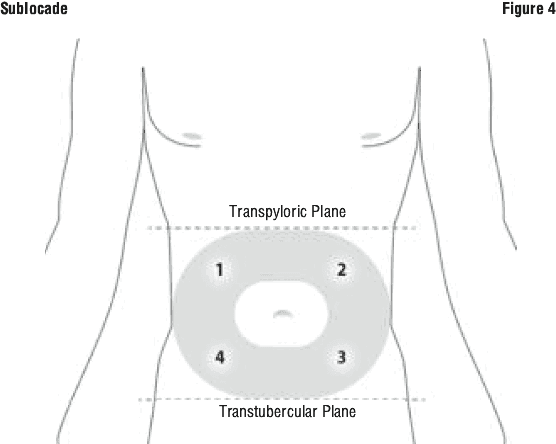
Rotating Injection Sites
Some providers may recommend rotating injection sites to reduce the likelihood of skin irritation.
Most people move to a different spot each time, roughly an inch or more from the last one. Using the same area repeatedly can make the tissue firm over time, and medication tends to absorb less predictably from tissue like that. Areas that are bruised, tender, hard, or scarred are generally avoided.
Your clinician will advise you if site rotation is appropriate for your prescribed medication. Do not modify your injection routine without consulting your provider.
Storing Your Medication
Storage instructions come with your prescription and vary by medication. Where refrigeration is indicated, most people keep it in the main body of the refrigerator rather than the door, and away from the freezer, since freezing can ruin many of these medications. If something has been frozen, most people contact their care team rather than using it.
Follow the storage directions provided by your dispensing pharmacy, which are specific to your medication.
When to Contact Your Provider
Reach out to your healthcare provider if you experience:
Persistent redness or swelling at the injection site
Pain that does not resolve
A hard lump at the injection site that does not go away
Signs of infection
Any mismatch between the dose on your vial label and the dose on your paperwork
Any uncertainty about administration
Your provider is the best resource for addressing questions related to your prescription.
Important Reminder
Always follow the instructions provided by your prescribing clinician and dispensing pharmacy.
Do not adjust your dosage, frequency, or method of administration without medical guidance.
Never change your dose on your own, in either direction. Not to make up for a missed dose, and not to speed up results. Your prescribed number is set deliberately. If you think your dose is wrong, that is a conversation with your provider, not a change to make at the kitchen counter.
If you are unsure about any aspect of your medication or injection process, contact your licensed healthcare provider before proceeding.
Educational Disclaimer
This material is provided for general educational purposes only. It describes practices commonly followed by patients administering subcutaneous medications at home, and it does not constitute medical advice, clinical training, or instruction for any individual prescription. It does not replace individualized instructions from a licensed healthcare provider. Always follow the guidance provided by your prescribing clinician and dispensing pharmacy regarding your medication, your dose, and your administration technique.